A distinct priming phase regulates CD8 T cell immunity by orchestrating paracrine IL-2 signals
Katarzyna Jobin , Deeksha Seetharama , Lennart Rüttger, Chloe Fenton, Ekaterina Kharybina, Annerose Wirsching, Anfei Huang, Konrad Knöpper, Tsuneyasu Kaisho, Dirk H. Busch, Martin Vaeth, Antoine-Emmanuel Saliba, Frederik Graw, Alain Pulfer, Santiago F. González, Dietmar Zehn, Yinming Liang, Milas Ugur, Georg Gasteiger , Wolfgang Kastenmüller
Science, 2025Abstract
T cell priming is characterized by an initial activation phase that involves stable interactions with dendritic cells (DCs). How activated T cells receive the paracrine signals required for their differentiation once they have disengaged from DCs and resumed their migration has been unclear. We identified a distinct priming phase that favors CD8 T cells expressing receptors with high affinity for antigen. CXCR3 expression by CD8 T cells was required for their hours-long reengagement with DCs in specific subfollicular niches in lymph nodes. CD4 T cells paused briefly at the sites of CD8 T cell and DC interactions and provided Interleukin-2 (IL-2) before moving to another DC. Our results highlight a previously unappreciated phase of cell-cell interactions during T cell priming and have direct implications for vaccinations and cellular immunotherapies.
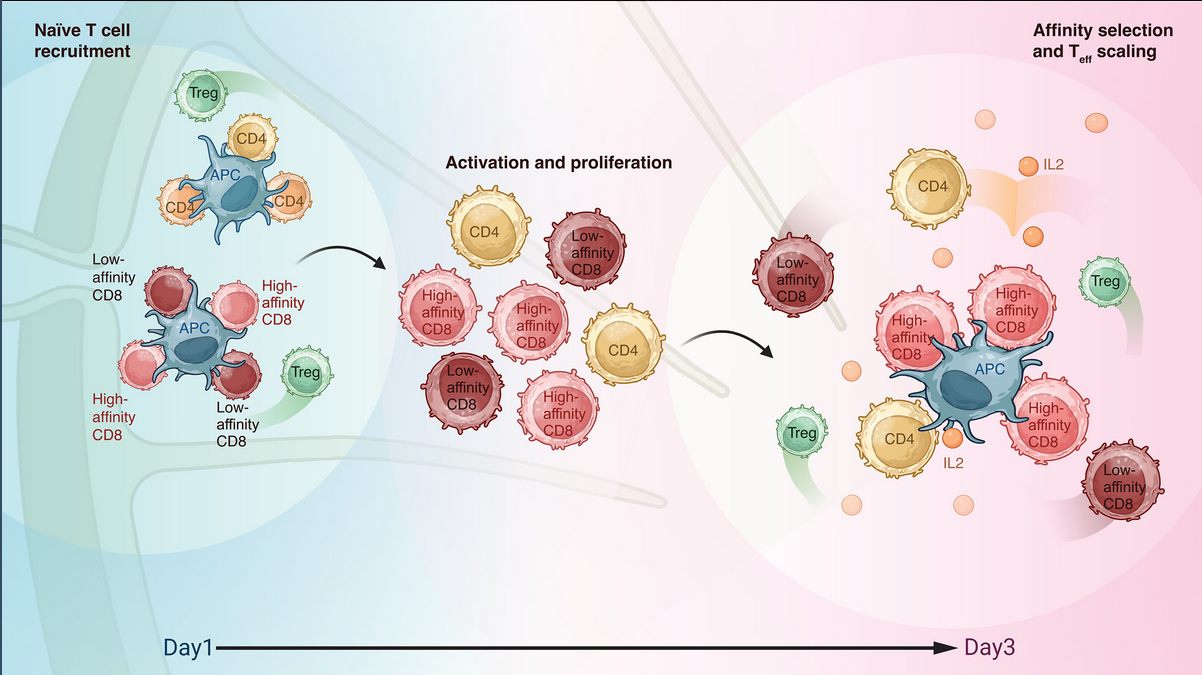
A model outlining the activation and subsequent selection of CD8 T cells during priming. In the activation phase (day 1), naïve T cells are recruited from a diverse repertoire and engage with DC for about 24 hours. After activation, T cells desensitize, detach from the DC, proliferate, and move to deeper areas of the lymph node. In the selection phase, activated T cells regain sensitivity (day 2 to 3) allowing high-affinity clones to reengage with antigen-presenting cells. At this stage, they receive critical aid from CD4 T cells that provide IL-2 through a stop-and-go migration pattern. Regulatory T (Treg) cells limit IL-2 availability as they migrate within the T cell zone. These processes collectively drive the expansion and effector differentiation of high-affinity CD8 T cells. Teff, effector T cell. [Figure created with BioRender.com]